By Isabella Colon, Class of ’26
In a world where plenty of food is produced only to be wasted, it’s time to confront the alarming reality: Our current food production systems are not sustainable.
Agriculture is the largest source of methane emissions caused by human activity – contributing to around 20-30% of all human-made greenhouse gas emissions. To break that down, around 24% of that contribution comes from farming/agriculture, with another 5-10% coming from the late stages in the food system: processing, packaging, transport, retail, preparation, and waste disposal.
In recent years, it’s become more clear that there’s an intricate connection between our current food production systems and climate change. In an interview with CBC News, Pascal Thériault, an agricultural economist at McGill University in Montreal, discusses the system in which we harvest our food – “[It] relies on stability, and what climate change does is it creates situations where nothing is stable,” Thériault said.
Climate change poses significant risks to global food security at various levels: Industrial livestock farming alone emits vast amounts of methane and nitrous oxide – potent greenhouse gasses. Deforestation driven by agricultural expansion contributes to carbon emissions and loss of biodiversity.
Rising temperatures, shifting precipitation patterns, and extreme weather events will disrupt the natural order of our food production system, potentially impeding food delivery, quality and prices, exacerbating food insecurity.

So why don’t we just expand agricultural land? Make the food production bigger and more expansive? That comes with its own set of consequences which could potentially only exacerbate already existing problems.
Some may suggest creating more farmland – Plowing down more land for crops furthers the destruction of natural habitats and ecosystems. What about hiring more labor to produce more yield? That entails relying on migrant workers who are frequently underpaid and work in horrible conditions.
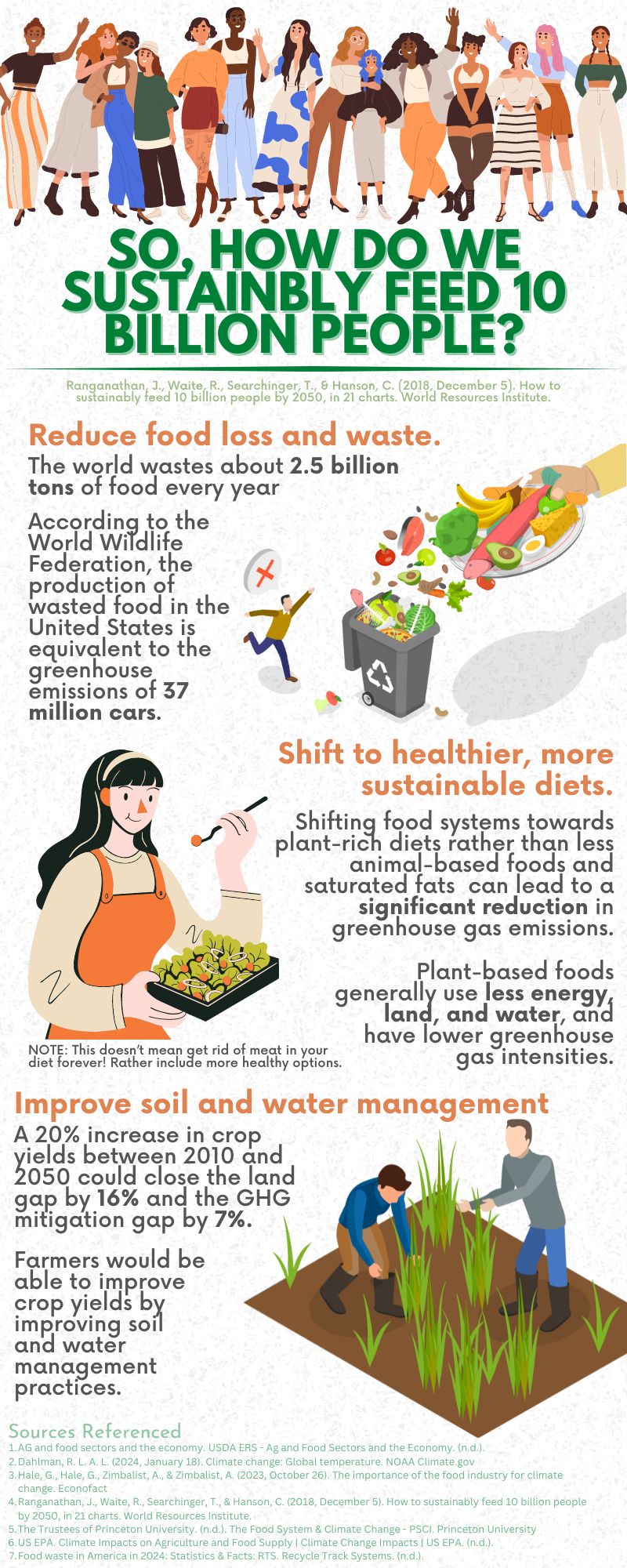
With the United Nations Department of Economic and Social Affairs predicting the world’s population projected to reach 10 billion by 2050, and data sourced from the UN Food and Agriculture Organization indicating that 44% of arable land is already dedicated to food production, the question arises: How can we meet the increasing demand without exacerbating environmental degradation?
The problem doesn’t come with a simple solution, rather it requires rapid change and a complete reform of our food production system. Reducing food waste, shifting towards diets that are both nutritious and eco-friendly, and advocating for reform in rethinking our agricultural systems is not just an idealistic vision; it’s a necessity for a better future. We are urged to play an active role in challenging the status quo.
Dr. Anna Brown, chair and professor of political science at Saint Peter’s University, emphasizes the need for systemic change, stating, “This work will be challenging and requires a commitment to study/read, action, reflection, and even spiritual work.”
As we aim to improve our current frameworks, we must envision a sustainable future and start engaging in vital conversations with communities – With 40.8 million members of Gen Z (ages 18-27 in 2024) being eligible to vote in 2024, it’s clear that young adults will be bearing the weight of this climate crisis.
In addressing the climate crisis, we must not only implement new policies and behaviors to help curve the consumption rates that harm our environment, but we must encourage people to step back and evaluate themselves – How much do you consume?
We must reevaluate our consumerist mindset – Instead of solely identifying as consumers driven by endless consumption, young adults must recognize their roles in an ever changing future. We must prioritize modest consumption and nourish ourselves with food that is healthier and more sustainably sourced. This becomes for the betterment of both our bodies and the planet.
“Do we have a vision of what we want to see? Have we engaged with others in this vital conversation? Do we know the world we wish to build? Do we know our neighbors, and have we cultivated relationships with community members to build our struggle?” Said Dr. Brown.
We are at a pivotal moment of change, with the choices we make today as new voters shaping tomorrow’s future. It’s time to listen to the call for sustainable food production and embark on the challenge that is a more equitable, resilient future.
Sources Referenced
- AG and food sectors and the economy. USDA ERS – Ag and Food Sectors and the Economy. (n.d.).
- Dahlman, R. L. A. L. (2024, January 18). Climate change: Global temperature. NOAA Climate.gov
- Hale, G., Hale, G., Zimbalist, A., & Zimbalist, A. (2023, October 26). The importance of the food industry for climate change. Econofact
- Ranganathan, J., Waite, R., Searchinger, T., & Hanson, C. (2018, December 5). How to sustainably feed 10 billion people by 2050, in 21 charts. World Resources Institute.
- The Trustees of Princeton University. (n.d.). The Food System & Climate Change – PSCI. Princeton University
- US EPA. Climate Impacts on Agriculture and Food Supply | Climate Change Impacts | US EPA. (n.d.).
- Food waste in America in 2024: Statistics & Facts: RTS. Recycle Track Systems. (n.d.).
- Competence centre on foresight. Global population is growing | Knowledge for policy. (n.d.).
- Hannah Ritchie and Max Roser (2019) – “Half of the world’s habitable land is used for agriculture” Published online at OurWorldInData.org.
- Ellis, E. C., Klein Goldewijk, K., Siebert, S., Lightman, D., & Ramankutty, N. (2010). Anthropogenic transformation of the biomes, 1700 to 2000. Global Ecology and Biogeography, 19(5), 589-606.
- 41 million members of gen Z will be eligible to vote in 2024 . Circle at Tufts. (2023, October 18).
 The Dirt on Jersey City